
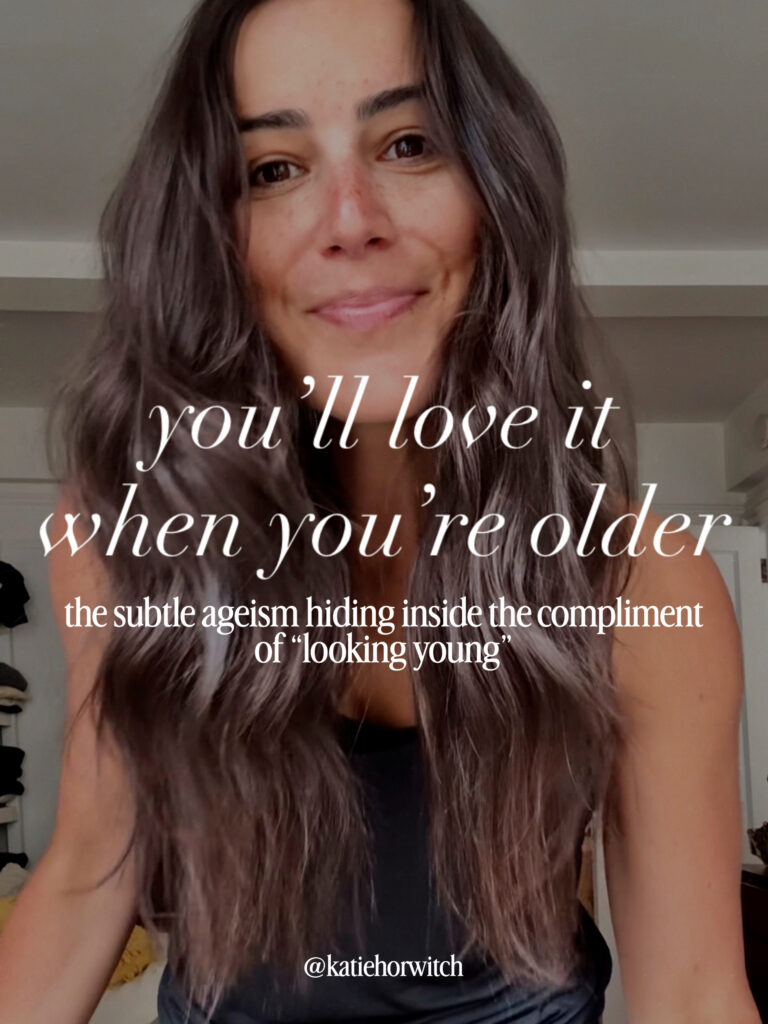
My first introduction to ageism came very early, and in a very odd way that might not seem ageist at all: by getting told incessantly how much younger I looked than I actually was.
This was, I learned to infer, a compliment. It was something meant as praise.
As a kid, I was often mistaken for older. This also was meant as a compliment.
Sometime around my early twenties, the compliment shifted from older to younger. And I hated it.
I didn’t want to look sixteen. I wanted to look twenty-two. I didn’t want to look twenty-two. I wanted to look almost-thirty. Not only do you look “so young,” you act way older than you are! I learned this quickly: apparently the ideal combo was to look younger than I was but carry myself older.
And then, the clincher. Whenever I would get this compliment, it was immediately followed by six specific words:
You’ll Love It When You’re Older.
The problem with receiving compliments based on things that inevitably change over time — namely, your age and your shape — is that they can make you feel like your worth depends on those things. If you’re taught that part of your value comes from your age, shape, or size, what happens when those inevitably start to change?
Being praised repeatedly, and specifically, for looking younger taught me long before 40 that youth was something I was supposed to value — and eventually depend upon.
Now, just 15 days shy of my 40th birthday, I’m feeling this big time. When I tell people who don’t know my age what it is, their eyes widen.
I hear the echos of those complimenters of my past: you’ll love it when you’re older.
Well, here I am, older, supposed to be loving it…
I try to be present enough to take the compliment with the intention it was given, but detached enough that I don’t become dependent on it. Because the subtext in this very normalized compliment is: people thinking you are younger than you are is the “good” that overrides whatever is supposedly “bad” about the age you actually are.
I am so proud of my life from 0-39.
I don’t want to pretend I’m not where I am, because that erases so much of my story.
I also don’t want to set a dangerous precedent for my older self’s self-talk: that the best thing about getting older is looking like you haven’t.
The caveat that so many people give now within that compliment — “You look amazing For Your Age” — implies that this actually isn’t how a 40 year old is supposed to look. But I also think…do we actually understand the wide spectrum of what 40 looks like? Or 50? Or 60, 70, 80, 90+?
There is no normal. There is no bad or good. There just IS. And the more we can embrace people where they are sans caveats, I think, the wider we will open the doors of possibility to all ages and stages no matter how they look “at their age.”
(The hill I will die on: the only way to “not age well” is to be an asshole.)

0 Comments